Science pictures that look like Alberta
September 25, 2026 · The Eduverse team
Open a typical science workbook to the food-webs page and you'll usually meet a lion chasing a gazelle. It's not wrong — it's a real predator and real prey — but for a child in Red Deer it quietly files the whole subject under somewhere else. The savanna is where science happens; Alberta is just where you live.
We think the pictures in a science lesson should answer a different question — the one children actually ask first when they look at any image: "is this my world?"
Alberta's curriculum says "local." It doesn't say which local.
Here is the thing most people assume and almost nobody checks. Alberta's Grade 7 science curriculum does not hand you a species list. Search the Program of Studies for boreal, prairie, lynx or magpie and you will not find them. What it asks for is this:
Monitor a local environment … investigate a variety of habitats … identify signs of ecological succession in local ecosystems.
"Local" is the requirement. Which local is an editorial decision — and it is one that every resource quietly makes on your child's behalf. A workbook printed for a continental market makes that decision once, generically, for everyone. We make it for Alberta.
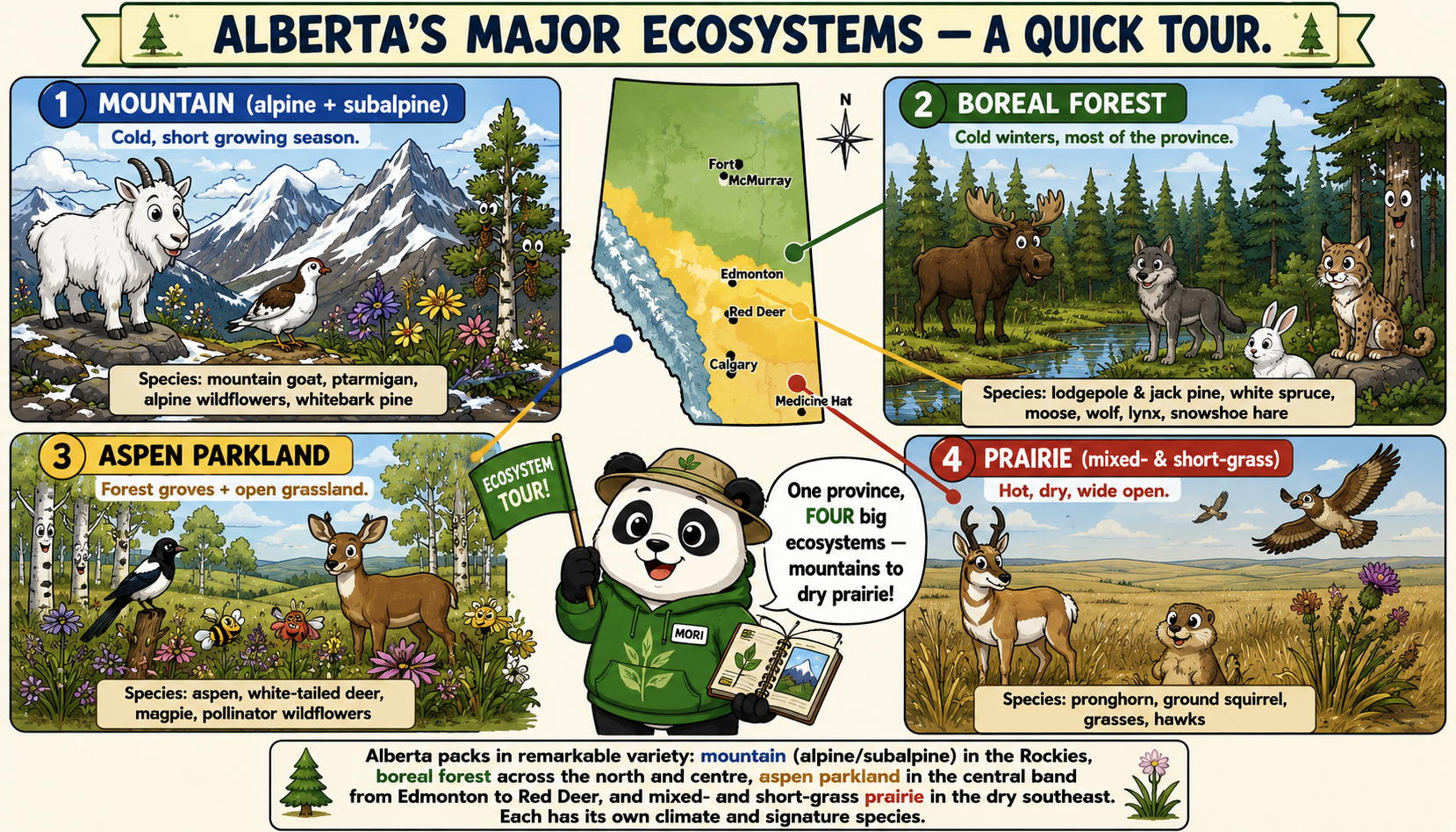
From the opening lesson of our Grade 7 ecology unit. Four ecosystems, one province — and a map with Red Deer on it.
So when the unit gets to predators and prey inside a food web, the pairs the lesson names are Alberta's: a lynx hunting a snowshoe hare in the boreal forest, a great horned owl catching a deer mouse at the edge of a Calgary park, a pike striking a perch in a Saskatchewan-river backwater, a wolf pack working an elk in the Rocky Mountain foothills.
That owl is not a decorative choice either. The great horned owl is Alberta's official bird — adopted on May 3, 1977, after a provincewide children's vote. A child who has watched magpies work a roadside, or heard about a lynx sighting near a campground, brings real memories to that page.
A picture should teach even if the words are ignored
We assume a twelve-year-old will look before they read — and sometimes only look. We design for that instead of against it: the shape of an image should carry the idea, so a child who reads nothing still learns something.
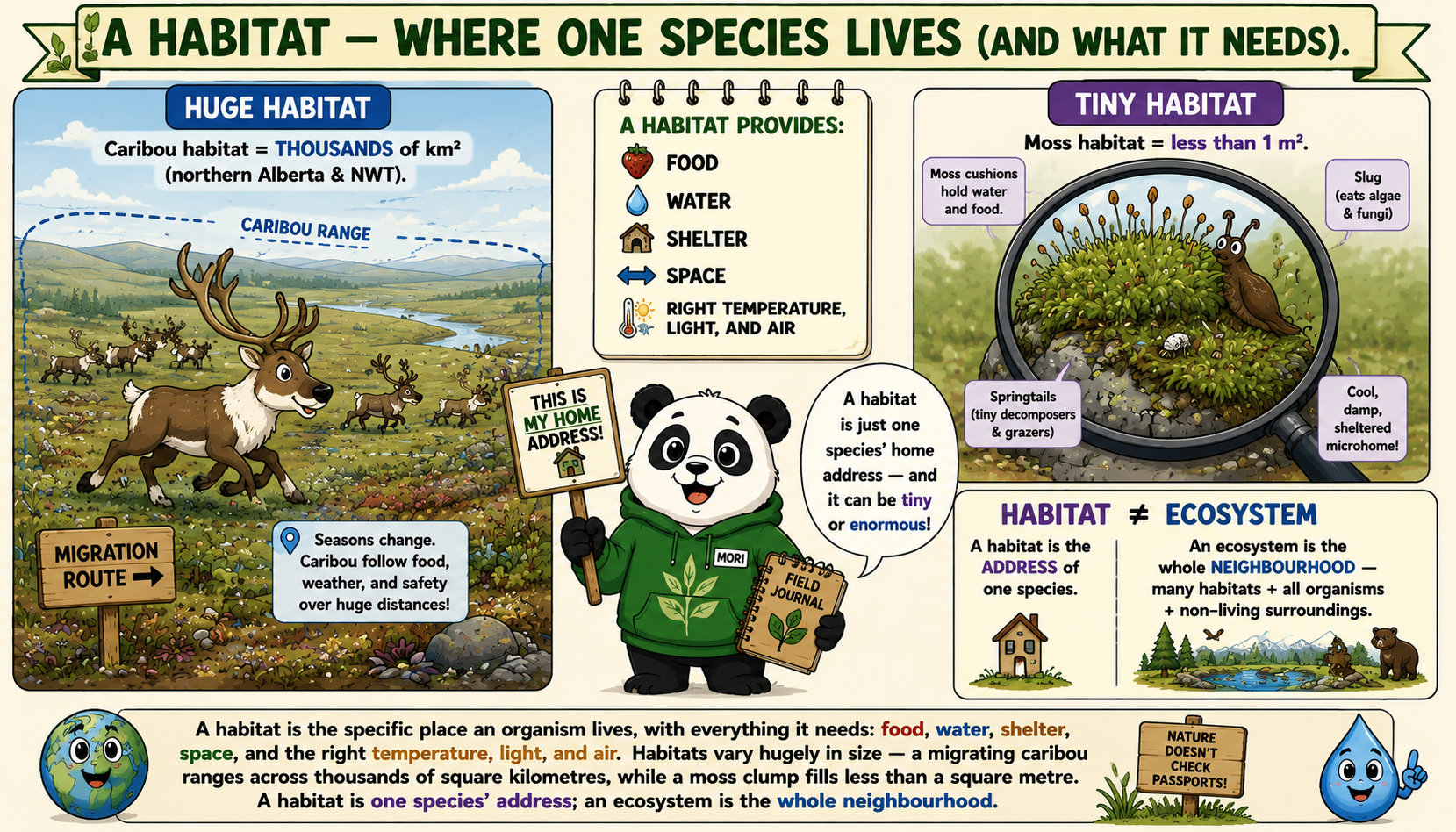
Cover the labels with your thumb. A herd crossing open country next to a magnifying glass on a clump of moss still teaches the idea: a habitat can be enormous or tiny, and it is one species' address rather than the whole neighbourhood.
That thumb test is one we'd suggest for any resource: hide the labels and ask what the picture still says. If the answer is "nothing — it's decoration," the image isn't helping your child learn.
Honest about where Alberta ends
Being local is not the same as pretending the rest of the world doesn't exist. Alberta's curriculum asks students to compare ecosystems, which means some lessons have to leave the province — and when ours do, they say so on the page.
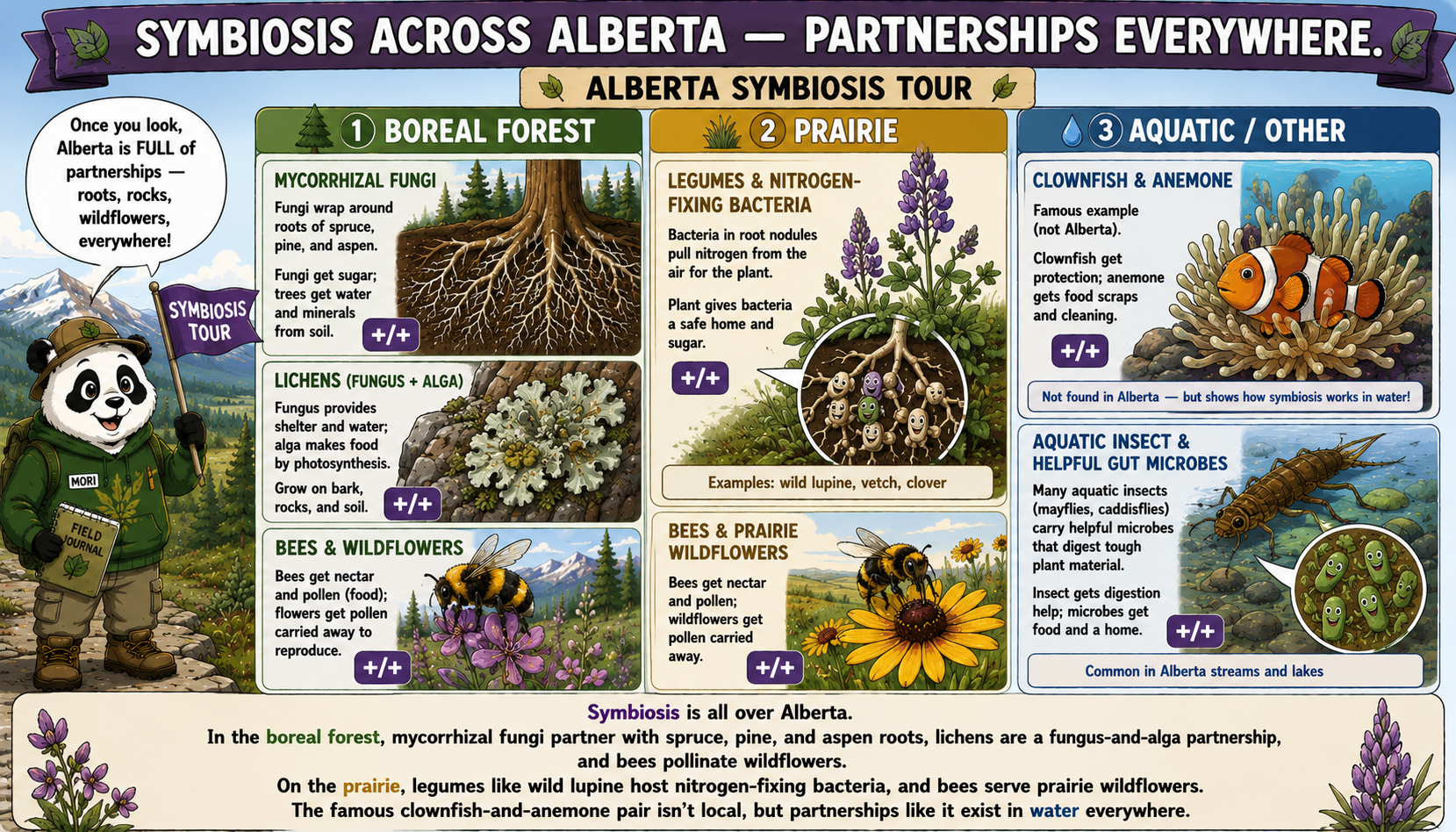
The clownfish is the famous symbiosis example in every textbook. It is also labelled, right on the panel, as not found in Alberta — because a child should know which pictures are their world and which are borrowed.
The same honesty applies to the numbers. Our Grade 7 and Grade 9 lessons both teach the "10% rule" — that roughly a tenth of the energy at one level of a food web makes it to the next — and both are careful to say what it actually is. In the lesson's own words: the "10%" is an average, not a law, and warm-blooded animals often pass up less than that, sometimes only 2–5%. A tidy number is a teaching tool. Presenting it as a measured fact of nature would be the same shortcut as drawing an Alberta food web with a lion in it.
What to look for in any resource
Whether or not your family uses Eduverse, the same questions work on any science resource you're considering:
- Is this my child's world? Do the habitats, seasons, and species match what they can see — or does everything happen on a savanna?
- Does the picture pass the thumb test? Cover the labels. Does the image still teach?
- Are the characters consistent? Children track recurring characters like friends. Flip between two chapters and check the guide is still the same character — one who changes from page to page breaks that quiet bond. (Ours is Mori, the panda in the green hoodie in all three panels above.)
- Does it admit what it borrowed? When a resource shows something from outside your province, does it tell your child that, or let them assume?
- Is it honest but warm? Nature includes predators and decay; good art neither hides that nor makes it grim.
Where we are
Eduverse was built by a certified Alberta teacher, and our art brief holds illustrations to the same standard as the lessons: where the curriculum calls for a local example, draw a local one — real Alberta species and real Alberta places, not stock imagery.
We are also still filling in the picture. Large parts of our Grade 7 ecology unit are text and diagrams today while that art is being made, and the lessons on predators, scavengers and decomposers are among those still waiting for it. We would rather tell you that than show you a gallery and let you assume it runs end to end.
Sources: Alberta Education's Science (7–8–9) Program of Studies, 2003 (Updated 2009, 2014), checked September 2026 — the quoted outcome is from Grade 7 Unit A, "Interactions and Ecosystems." The great horned owl's status and adoption date are from the Government of Alberta's Emblems of Alberta. Curriculum documents do get revised, and a renewed Grades 7–9 science curriculum is in draft — alberta.ca is always the final word.