Science Words to Know: Four Ways to Practise Them at Home
September 8, 2026 · The Eduverse team
A child can understand an idea and still get stuck on its technical name.
They may be able to tell you exactly what happens when a puddle dries in the sun, then hesitate the moment "evaporation" shows up in a lesson or needs to be written down. That hesitation doesn't mean the idea was missed. In one study, four- to seven-year-olds watched a short science video: it raised what they knew about the topic, while their grasp of the new words themselves barely moved. Out of four target words, they could pick the right picture for an average of 2.63 of them — but produced the word themselves for an average of 0.12. Those were deliberately rare terms, chosen because the children were confirmed not to know them, rather than everyday curriculum words. But the split it shows — having the idea, lacking the name — is the one we plan around, and it is why we treat the two as separate things to check.
That is where subject-specific literacy belongs in science: not as a surprise spelling test, and not as a substitute for understanding, but as support for reading, discussing, and explaining scientific ideas.
What “based on the curriculum” means
Alberta's curriculum identifies the science knowledge and skills students are expected to develop. Eduverse organizes key terms connected with those grade-level topics into Words to Know lists for Grades 1–9.
The distinction matters: these are Eduverse learning aids built around Alberta science curriculum content. They are not official provincial science spelling lists, and they are not a complete literacy program.
They are also not exhaustive, and we would rather say so plainly than let you assume otherwise. A Words to Know list is a curated selection of terms for a unit — enough to give a child a solid handle on the language of that unit — not every word the unit contains, and not a checklist that certifies a grade has been covered. If your child works through the whole list, that is genuinely useful; it is not a guarantee that no science word has been missed. The lessons themselves, and the curriculum your child is working from, remain the source of truth for what is required.
Inside Eduverse, a family can open the Words to Know list for the current science unit or for the whole grade. Each entry includes the term and a definition. Learners can hear individual terms read aloud in a supported browser, and the list can be printed or saved as a PDF.
The goal is not to hand a child a giant list and say, “Memorize this.” It is to make the language of the science they are studying visible and easier to revisit.
One word bank, different kinds of practice
Seeing a word, spelling a word, rebuilding it from letters, and recalling what it means are related tasks, but they are not identical. Eduverse therefore offers more than one way to work with science vocabulary.
Spelling earns a place here for a particular reason, and it is worth being precise about what that reason is. Recognizing a word on a page is generally easier than producing it from memory — the same gap between pointing and naming that the study above found. When a child can spell evaporation without it in front of them, that is a signal the word is theirs to use — in a sentence, in an explanation, in a lab write-up — rather than something they can only pick out when they see it. The spelling is not the point. It is a check on whether the word has become available.
We are not claiming that spelling accuracy is how science understanding is measured. In Alberta it plainly is not. The word "spell" does not appear anywhere in the current K–6 science curriculum or in the Grades 7–9 program of studies — spelling is an English Language Arts and Literature outcome, not a science one. And neither Science provincial achievement test has a written-response section to spell in: the Grade 9 test is 55 questions of various formats, each worth one mark, and its own subject bulletin promises that "if a word that warrants a definition is used on a test, it will be defined on the page on which it appears."
What Alberta does ask for is the correct use of the terminology. Grade 8 science asks students to "use appropriate vocabulary, including correct science and technology terminology, to communicate ideas, procedures and results." That is the thing worth practising — and a child who explains a concept clearly in imperfect spelling has done the science. It is why the activities below are built for low-stakes repetition and missed-word review rather than scoring.
1. Spelling Bee: hear it and spell it
Spelling Bee opens on a choice of three modes: Practice, which shows the definition and asks the child to spell the term; Timed Test, which races a clock; and Spelling Bee itself, which reads the word aloud and asks them to type it without seeing it. They can replay the word, and every word in the activity comes with an example sentence — in Spelling Bee mode that sentence can be read aloud too. The activity groups words by length and lets learners revisit missed words.
There is also a Word of the Day — one term drawn from the unit, refreshed daily, flagged as a 2× XP bonus word. Treat it as a reason to open the tab on a slow morning rather than as a measure of anything. Skipping it costs your child nothing, and the points are a nudge, not a grade.
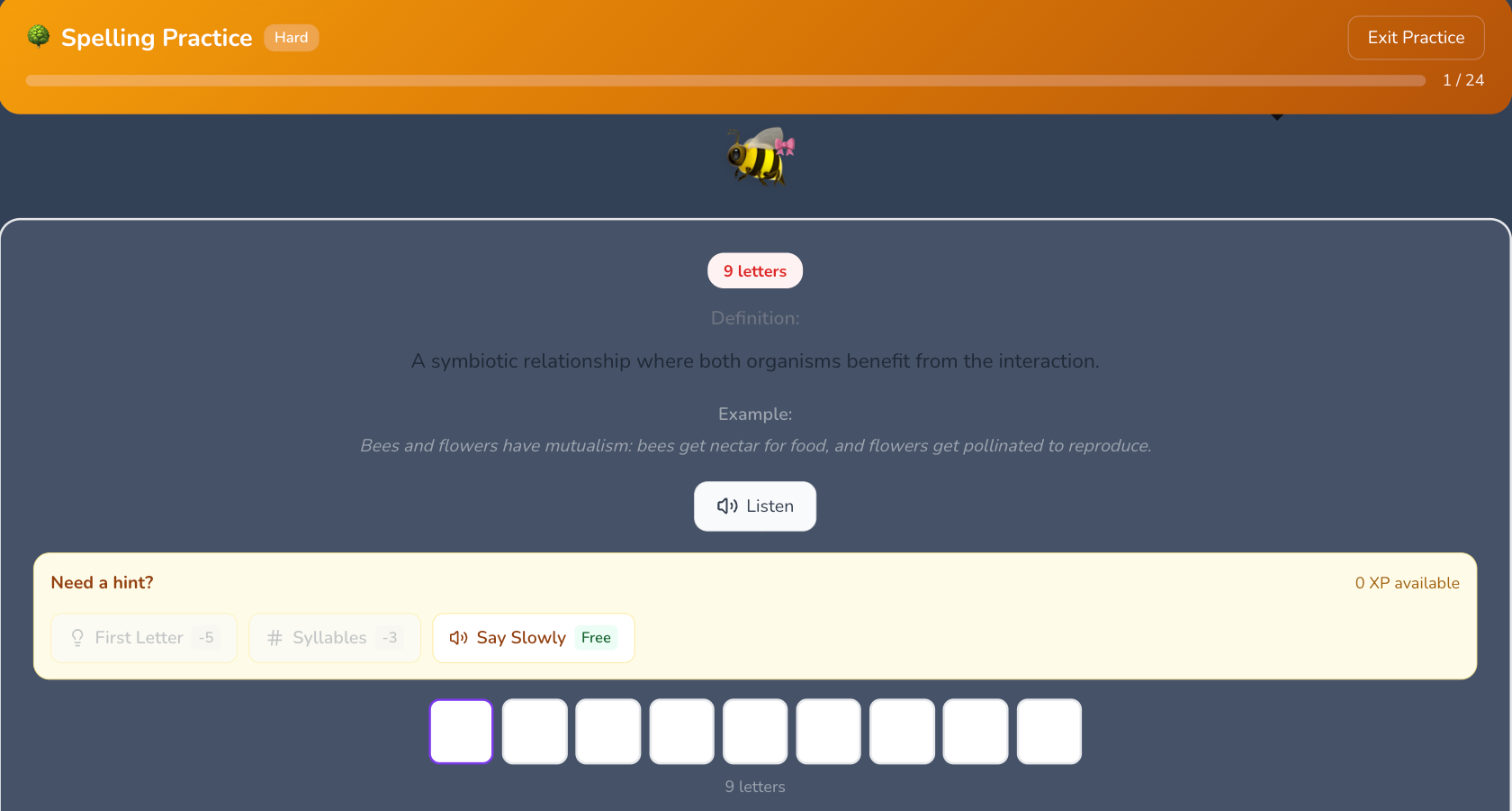 Practice mode shows the definition and the example sentence, then leaves one box per letter. The hints are optional and cost points, so a child chooses whether to use them.
Because the activity uses browser speech synthesis, whether audio works—and which voice is used—depends on the learner's browser and device.
2. Word Unscramble: rebuild it
Word Unscramble uses the same unit glossary source as Spelling Bee. The learner receives the letters in a mixed order and rebuilds the word. A definition is shown while the learner rebuilds the letter pattern, so the activity presents spelling alongside meaning.
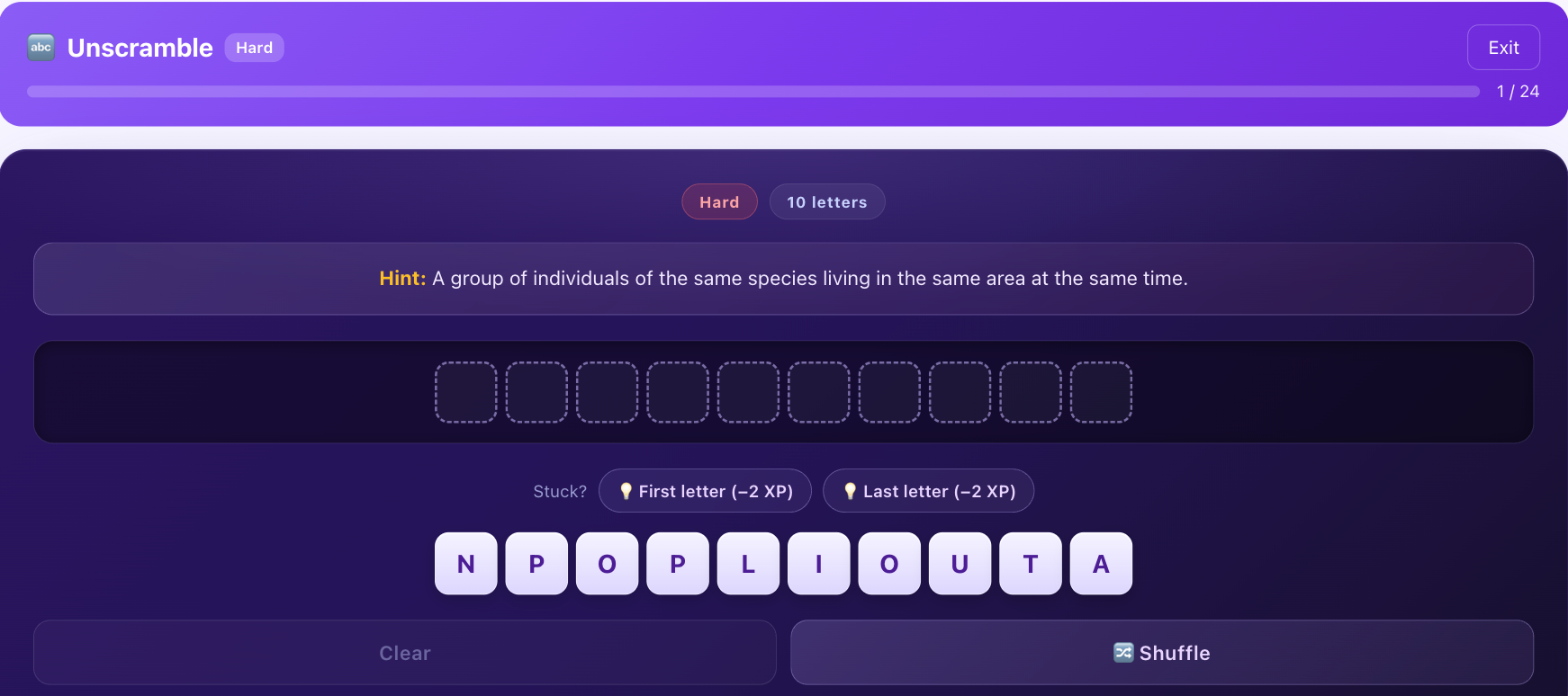 The definition stays on screen while the letters are rearranged, so the word and its meaning are being handled at the same time. Shuffle re-deals the tiles.
Both activities use only single words made of letters, with hyphens allowed. Multi-word phrases can still appear in Words to Know, but they are not sent into Spelling Bee or Word Unscramble.
3. Flashcards: retrieve and explain
Eduverse's science topic flashcards use a front-and-back format: the learner reads a prompt, tries to answer, and then flips the card to check. For signed-in learners, review mode also lets them rate a card as hard, good, or easy so it can be scheduled for another review.
The flashcards complement the glossary; they are not simply a duplicate of every Words to Know entry. They ask the learner to recall and explain a science idea rather than only recognize a term.
In two experiments with university undergraduates studying short prose passages, repeated study produced better recall five minutes later, but free-recall testing produced better retention a week later — and, in the experiment that also included a two-day delay, after two days as well. That finding supports retrieval practice in principle; it did not test children, science-vocabulary flashcards, or this routine. A flashcard is still a practice tool—not the lesson itself.
4. Word Roots: the parts the words are built from
Beside the word list sits a Word Roots tab — a dictionary of the Greek and Latin building blocks that keep reappearing inside science vocabulary. Each entry gives the root, how to say it out loud, the language and original meaning it comes from, what it tends to signal in science, and a set of example words drawn from the science vocabulary Eduverse actually teaches rather than from a generic word list. A speaker button reads an example aloud, and the dictionary can be searched by root, by meaning, or by a word your child is curious about. Roots that suit younger readers are marked with a star, and one filter narrows the whole dictionary down to just those.
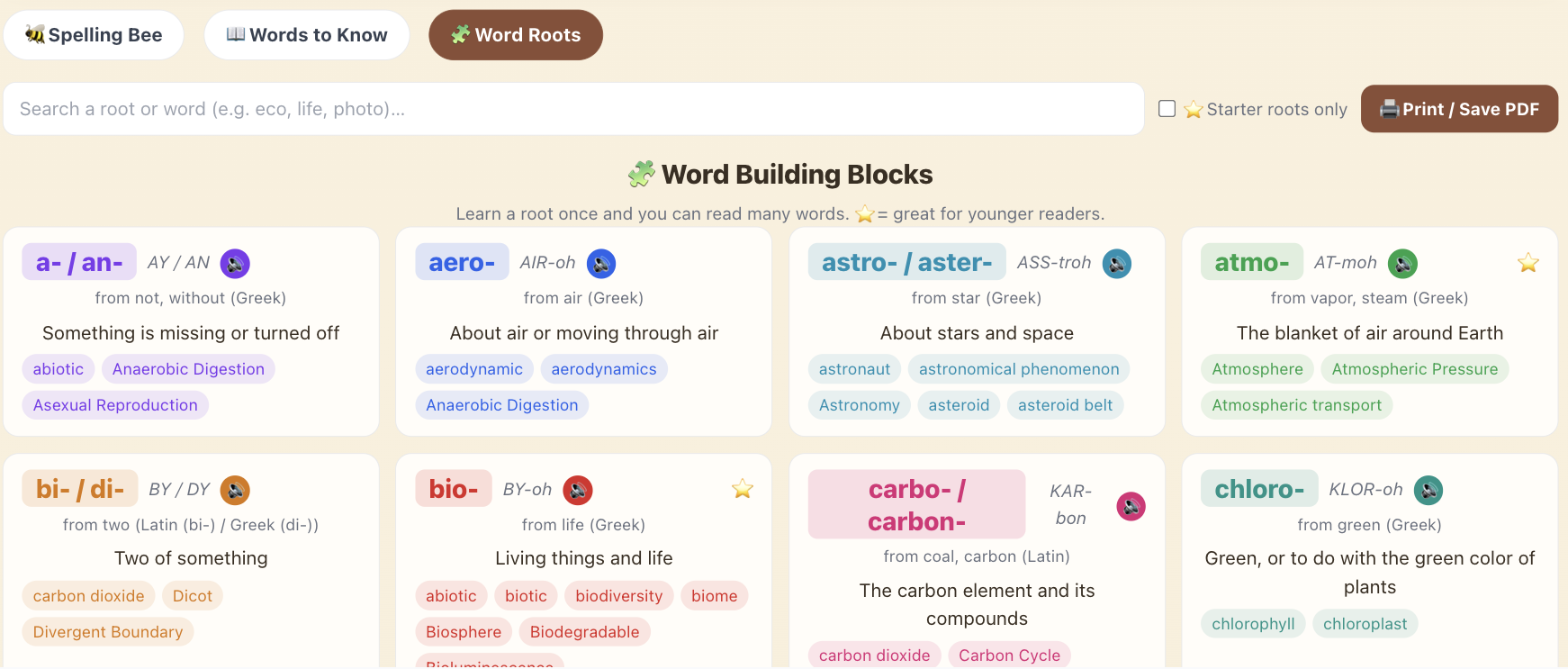 Each card carries the root, a pronunciation, where it comes from, what it signals in science, and the words it unlocks. The ⭐ marks roots that suit younger readers, and the checkbox above narrows the whole dictionary to just those.
This is the part that stops spelling being a word-at-a-time exercise. A child who learns that bio- means life has a way into biotic, biome, biosphere, biodiversity and bioluminescence — including the ones they have not met yet. And in Words to Know, a term that contains a root we have mapped carries that root as a small tag beside its definition, so the connection shows up while they are reading the list rather than sitting in a separate lesson.
Not every glossary term has a root worth flagging, and the tags only appear where the match is genuine — a word is not decorated with a root it does not actually contain.
A short routine for a home education week
You do not need to use every activity every day. Try a small loop:
- At the beginning of a science topic, open the unit's Words to Know and choose a manageable handful to notice. Read the definitions together and listen to unfamiliar words.
- Later in the week, let your child use Spelling Bee or Word Unscramble for a different encounter with the same unit language.
- Finish with a few topic flashcards. Ask your child to explain one answer in their own words before flipping the card.
If a word keeps causing trouble, look it up in Word Roots before drilling it again. Knowing that the front half of the word already means something is often what makes the rest of it stick.
If a spelling attempt is wrong, keep the conversation low-stakes: “Which part sounded different from how it is written?” If a definition is forgotten, return to the lesson or an example. The point is to uncover what needs another look, not to turn every word into a grade.
Why we are showing our work
Eduverse is built in Alberta by a certified Alberta teacher, and we want parents to know exactly what we mean when we say a resource is curriculum-based. We use Alberta's science curriculum to set the grade and topic context, then build learning supports around that content. And we should be clear about what comes from the province, what Eduverse has created, and what each activity can — and cannot — do.
For this feature, that means a grade- and unit-organized science glossary, two word-building activities drawn from the glossary, topic flashcards for recall, and a word-roots dictionary built from the words our own glossary actually uses. It does not mean the province has issued an official science spelling list, and it does not mean spelling practice replaces teaching the science.
That difference may sound small. For families deciding what to trust, it is not.
What science word has sparked the best conversation—or the most confusion—in your home this year?
Sources: Alberta Education and Childcare's current Science (K–6) curriculum — K–3 implemented in the 2023/24 school year, Grades 4–6 in 2024/25, with minor revisions for 2026/27 — the science overview, and the current Science (7–9) program of studies (Science Grades 7–8–9, 2003, updated 2014; PDF), from which the Grade 8 terminology outcome is quoted and in which the word “spell” does not occur. Provincial testing details are from Alberta's Grade 9 Science subject bulletin for 2025–26. Research: Dockrell, Braisby and Best, “Children's acquisition of science terms: Simple exposure is insufficient,” Learning and Instruction, 17(6), 2007, 577–594 (author manuscript) — the comprehension and production means quoted above are from its results; Roediger and Karpicke, “Test-Enhanced Learning: Taking Memory Tests Improves Long-Term Retention,” Psychological Science, 17(3), 2006, 249–255 (PubMed). The Web Speech API is a Draft Community Group Report incubated by the W3C Audio Community Group and is expressly not a web standard. Product behaviour and published glossary coverage were checked against Eduverse's production database and origin/main on September 8, 2026. Curriculum and product features can change; consult Alberta's official curriculum for the current provincial requirements.